
OLFACTORY TRAINING
Your sense of smell can be trained.
Olfactory training is intentional smelling practice over a period of months.
Originally studied as rehabilitation for smell loss, it is now being investigated across healthy aging, cognition, neurological conditions and more.
Not aromatherapy. Deliberate sensory enrichment.
Successfully practicing Olfactory Training involves:
4 odours
Practicing twice daily
~20 seconds engagement per odour
3-6 months
A few sniffs are an experience. Repeated practice is training.
Healthy adults & healthy aging
Researchers have studied people with normal smell to investigate sensory performance, cognition, well-being and brain plasticity.
People rebuilding their sense of smell
Including post-viral and post-COVID smell loss, head injury, idiopathic smell loss, parosmia and some sinonasal conditions.
Cognitive & neurological conditions
Including mild cognitive impairment, dementia and Parkinson's disease.
Emerging areas of research
Recent studies extend into conditions including type 2 diabetes, chronic kidney disease and other populations in which olfactory dysfunction is common.
Who can benefit from Olfactory Training (OT)?
What happens when we deliberately exercise a sensory system that most of us rarely train at all?
30+ published studies have used the classic four-odour olfactory training approach. Each also has a growing body of research for health-promoting qualities!
A protocol with a research history…
ROSE
Researched as: anti-inflammatory · antioxidant · antimicrobial · analgesic · mood-related
LEMON
Researched as: anti-inflammatory · antioxidant · antimicrobial · antiparasitic
CLOVE
Researched as: anti-inflammatory · antioxidant · antibacterial · antifungal · analgesic · antiseptic
EUCALYPTUS
Researched as: anti-inflammatory · antioxidant · antibacterial · antifungal · respiratory
OT researchers have reported significant changes in:
SMELL FUNCTION
Including identification, discrimination and detection threshold.
VERBAL FLUENCY
Improvement has been reported in studies of older adults.
MEMORY & COGNITION
Some studies have found changes in short-term memory, verbal learning and global cognitive scores.
MOOD & WELL-BEING
Improved well-being and reduced depressive symptoms have been reported in some populations.
BRAIN STRUCTURE
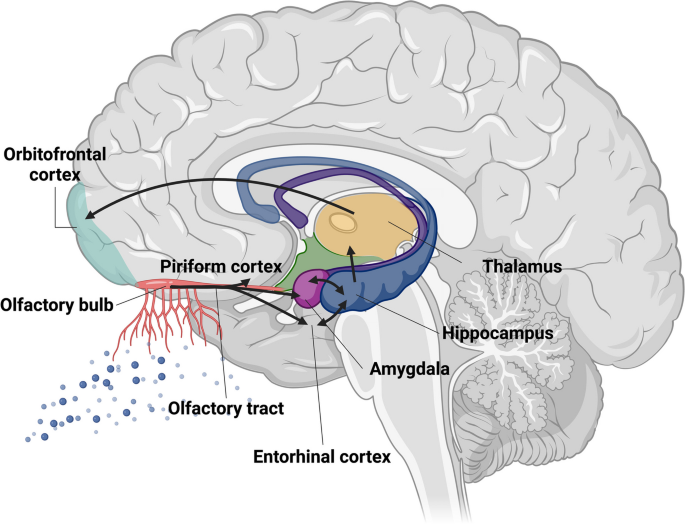
Studies have reported changes in grey matter, cortical thickness and olfactory-bulb volume.
BRAIN FUNCTION
Researchers have also observed changes in activation and connectivity within olfactory and cognitive networks.
What are realistic expectations?
Olfactory training is not usually a dramatic overnight experience. Changes can be gradual, individual responses vary, and some people notice very little (note: we may not notice a change even when there is one).
But the practice includes an additional benefit by asking you to pay attention to smell.
Over time, you may find yourself noticing odours more often, trying to identify them, comparing them and becoming more aware of changes in your own sense of smell. This increase in attention can boost enjoyment of food, taste, and smell in its own right!
Tips for Success:
Make it easy to remember.
Combine OT with another habit (brushing teeth, medication) and leave your kit somewhere visible (like a nightstand, countertop).
Keep going.
Mark your calendar and do the full 6 months. Do monthly check-ins.
If you miss a day, don’t stop, start again tomorrow.
Engage.
Make your training intentional and engaging.
Utilize ‘bimodal’ training by looking at images to coincide with smells (can boost results!) or imagining visuals and invoking memories.